
Three-letter words starting with T are among the most versatile in English. They appear in everyday conversations, games, early reading exercises, and even in technical contexts. Because T is one of the most frequently used consonants in English, these short T-words show up everywhere—from simple verbs like try and tap to nouns like tin, tie, and tan.
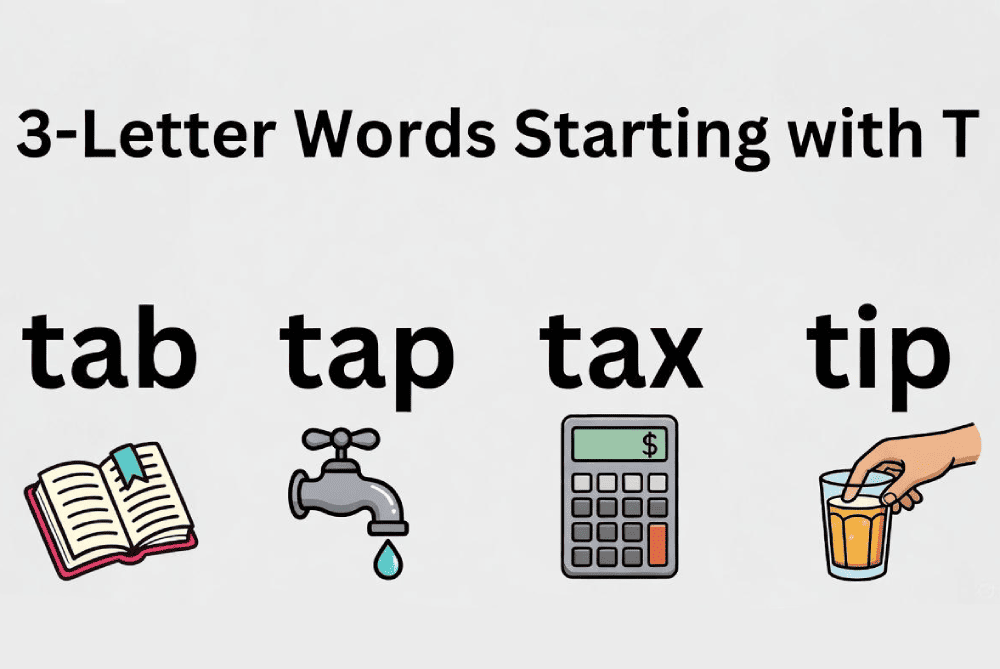
Learning 3-letter words starting with T is especially helpful for students, language learners, and word-game players. These small but powerful words build a stronger vocabulary foundation, help with pronunciation practice, and improve reading fluency. Whether you’re building spelling skills or boosting your Wordle and Scrabble performance, this list is a great tool.
📚 Full List of 3-Letter Words Starting with T
Below is a helpful list of the most useful and accepted 3-letter words starting with T:
3-Letter Words starting with T77
✅ 3-Letter Words Starting with T — Meanings & Example Sentences
| Word | Meaning | Example Sentence |
|---|---|---|
| taa | A no-longer-used musical syllable; also dialect for “thanks” (South Africa). | “Just give me a minute, taa.” |
| tab | A small flap or bill; also a restaurant bill. | “Put it on my tab, please.” |
| tad | A small amount. | “Move it just a tad to the left.” |
| tae | Scots word meaning “to.” | “We walked tae the village.” |
| tag | A label or marker. | “Attach a name tag to your bag.” |
| tah | Expression of mock thanks or surprise (British). | “Oh, tah, that was very kind of you!” |
| tai | A type of Japanese snapper fish. | “We ordered grilled tai at the restaurant.” |
| taj | A crown or jeweled headdress in South Asia. | “The prince wore a golden taj.” |
| tam | A round Scottish cap. | “He wore a wool tam in winter.” |
| tan | Light brown color; also to become sunburned. | “Her skin began to tan in the summer.” |
| tao | The Chinese concept of “the way” or natural order. | “Tao philosophy teaches harmony.” |
| tap | To strike lightly; a faucet. | “Turn off the tap after washing.” |
| tar | A sticky black substance from coal or wood. | “The road smelled of hot tar.” |
| tas | Plural of ta (letter in Greek). | “The chart listed deltas and tas.” |
| tat | To make lace by knotting thread. | “She learned how to tat decorative edges.” |
| tau | A Greek letter (Τ, τ). | “Tau is used in many formulas.” |
| tav | Hebrew letter (ת). | “Tav is the last Hebrew letter.” |
| taw | To prepare animal skin into leather. | “They tawed the hide using natural oils.” |
| tax | A required financial charge. | “You must pay tax on your income.” |
| tay | Scots word for “tea.” | “Would you like some tay?” |
| tea | A drink made from tea leaves. | “She drinks green tea every morning.” |
| ted | To spread hay for drying. | “Farmhands went to ted the hay.” |
| tee | A support for a golf ball. | “Place the ball on the tee before swinging.” |
| teg | A sheep in its second year. | “The farmer checked on the young teg.” |
| tel | A prehistoric mound or hill settlement. | “Archaeologists dug at the ancient tel.” |
| ten | The number 10. | “She scored a perfect ten.” |
| tep | A small fish; dialect word. | “The fisherman caught a tiny tep.” |
| ter | Archaic form of “thrice” (three times). | “He repeated the chant ter.” |
| tet | Hebrew letter; also Vietnamese New Year (Tết). | “Tet is celebrated with family gatherings.” |
| tew | To work hard or struggle. | “He had to tew all day on the project.” |
| tex | Unit for measuring textile fiber weight. | “The yarn was labeled 20 tex.” |
| the | Definite article in English. | “This is the best day ever.” |
| tho | Informal spelling of “though.” | “I liked it, tho it was short.” |
| thy | Archaic “your.” | “Honor thy father and mother.” |
| tic | A small muscle spasm. | “His eye developed a nervous tic.” |
| tid | A small amount; tide (dialect). | “Just a tid of sugar will do.” |
| tie | A draw; also neckwear. | “The game ended in a tie.” |
| tig | A children’s chasing game (tag). | “Let’s play tig in the yard.” |
| til | Sesame; variant of “till.” | “The recipe uses til seeds.” |
| tin | A soft metal; a container. | “She stored cookies in the tin.” |
| tip | End or point of something; to give advice. | “Here’s a helpful tip for baking.” |
| tis | Contraction of “it is.” | “’Tis a beautiful evening.” |
| tit | A small bird (titmouse). | “A tit perched on the branch.” |
| tix | Informal for “tickets.” | “Got my concert tix already!” |
| tob | A Hebrew letter (variant of tav). | “The manuscript contains the letter tob.” |
| tod | A fox; also a weight of wool. | “A tod trotted across the field.” |
| toe | A toe on the foot. | “He stubbed his toe on the step.” |
| tog | Clothing; to dress up. | “They got togged up for the party.” |
| tom | A male turkey. | “A tom strutted around the farm.” |
| ton | A weight of 2,000 lbs. (US) or 2,240 lbs. (UK). | “The cargo weighed nearly a ton.” |
| too | Meaning “also” or “excessively.” | “I want to go too.” |
| top | The highest part of something. | “She climbed to the top of the hill.” |
| tor | A rocky hill or peak. | “We hiked up the granite tor.” |
| tot | A small child. | “The tot giggled happily.” |
| tow | To pull something behind a vehicle. | “They had to tow the car home.” |
| tox | Informal for toxicology test. | “The lab ran a tox screen.” |
| toy | A plaything. | “The child dropped her toy.” |
| try | To attempt. | “Just try your best.” |
| tsk | A clicking sound of disapproval. | “Tsk, you forgot again.” |
| tso | Tibetan title for “lake”; appears in names like “Tso Moriri.” | “We visited Tso Moriri in Ladakh.” |
| tub | A large round container. | “He filled the tub with warm water.” |
| tug | To pull hard. | “She had to tug the door open.” |
| tui | A New Zealand bird. | “A tui sang in the trees.” |
| tul | A unit of measurement in Turkey; rare. | “The fabric was measured in tul.” |
| tum | British slang for “tummy.” | “My tum hurts after eating too much.” |
| tun | A large cask or barrel. | “Wine aged in a wooden tun.” |
| tup | A male sheep (ram). | “The tup watched over the flock.” |
| tut | Expression of mild disapproval. | “Tut, that’s not correct.” |
| tux | A tuxedo. | “He wore a black tux to the wedding.” |
| twa | Scots word meaning “two.” | “Twa lads walked down the street.” |
| twas | Archaic “it was.” | “’Twas the night before Christmas.” |
| two | The number 2. | “They adopted two puppies.” |
| tye | A small enclosure or common pasture. | “The cattle grazed in the tye.” |
| tyg | A multi-handled drinking cup. | “The museum displayed a medieval tyg.” |
| tyn | To lose or perish (Scots). | “Take care not to tyn your way.” |
| typ | Abbreviation used in linguistics for ‘typical’. | “This form is typ in old manuscripts.” |
| tyr | Norse god associated with law and war. | “Tyr was honored by ancient warriors.” |
Common vs. Rare T-Words
There are many familiar 3-letter words such as tag, tap, ten, top, toy, tax, tie, tin, tar, and tan. These words appear frequently in speech and writing, making them highly useful for beginners and advanced learners alike.
Less common or rare T-words—such as taa, taj, tam, tau, teg, tom, tup, tut, tux, tyg, and twp—are still valuable in games like Scrabble or crossword puzzles. These unusual words often have roots in Scots, Old English, or are specific objects, animals, or cultural terms. Knowing both common and rare options gives you a strong advantage.
Usage in Word Games
Three-letter words starting with T are essential tools in games like Scrabble, 3-letter Wordle, Wordscapes, and similar puzzles. Because the letter T has a low point value but appears often on the rack, players frequently need short T-words to form quick, strategic moves.
- In Scrabble, rare T-words like tau, teg, taj, and twp can transform a losing round into a winning one.
- In Wordle-style games, words like try, tip, tap, tan, and top help you test vowels and consonants quickly.
- In crossword puzzles, common T-words often fill short slots or help break down trickier answers.
Learning a wide range of T-words improves speed, confidence, and overall gameplay strategy.
Spelling and Pronunciation Tips
Because many 3-letter words starting with T begin with consonant blends or contain vowels that sound similar, mastering them helps improve both spelling accuracy and pronunciation.
Helpful Tips:
- T + Vowel patterns: Words like tap, tip, top, tub help learners recognize how vowel changes affect meaning and sound.
- Silent letters: Few words starting with T have silent letters, but examples like two (not 3-letter T-word, but related) help learners understand patterns.
- Double consonants: Some T-words, such as tut or tss (rare), show repeated sounds that improve articulation practice.
- Homophones: Words like tee vs. te (rare) show how pronunciation connects to spelling.
These patterns make words starting with T a great tool for phonics lessons, ESL learning, or reading development.
Fun Activities / Worksheets (Optional)
Here are some activity ideas you can turn into worksheets for kids or learners:
1. Match the Word to the Picture
Include simple images for words like:
- toy, tap, tin, top
Students draw a line to match the correct picture.
2. Fill-in-the-Blanks
Example:
- _ _ p (top, tap)
- t _ n (tan, ten, tin)
3. Create New Words
Give learners the letter T and boxes for two more letters to encourage creativity:
- T _ _
4. Word Sorting
Sort T-words into categories:
- nouns (toy, tin, toe)
- verbs (try, tap, tug)
- adjectives (tan, taut)
5. Mini Word Search
Hide 5–10 T-words in a small grid for quick fun spelling practice.
These activities work well for classrooms, homeschooling, and early literacy programs.
Conclusion
Three-letter words starting with T may be short, but they pack a surprising amount of linguistic power. From everyday vocabulary to rare Scrabble gems, these words help learners improve spelling, reading, and problem-solving skills. Understanding and mastering this collection offers real benefits in both academic and recreational settings. Whether you’re a student, educator, or word-game fan, exploring T-words is a simple and effective way to strengthen your English vocabulary.