
Five-letter words are essential building blocks in English—long enough to express solid meaning but short enough to appear frequently in reading, writing, and word games. Among them, 5-letter words starting with B form a surprisingly large and useful group. The letter B introduces words across every category: everyday speech, descriptive language, actions, academic terms, and even fun, playful expressions. Whether you’re learning English, expanding your vocabulary, or sharpening your puzzle skills, exploring B-words is a powerful step.
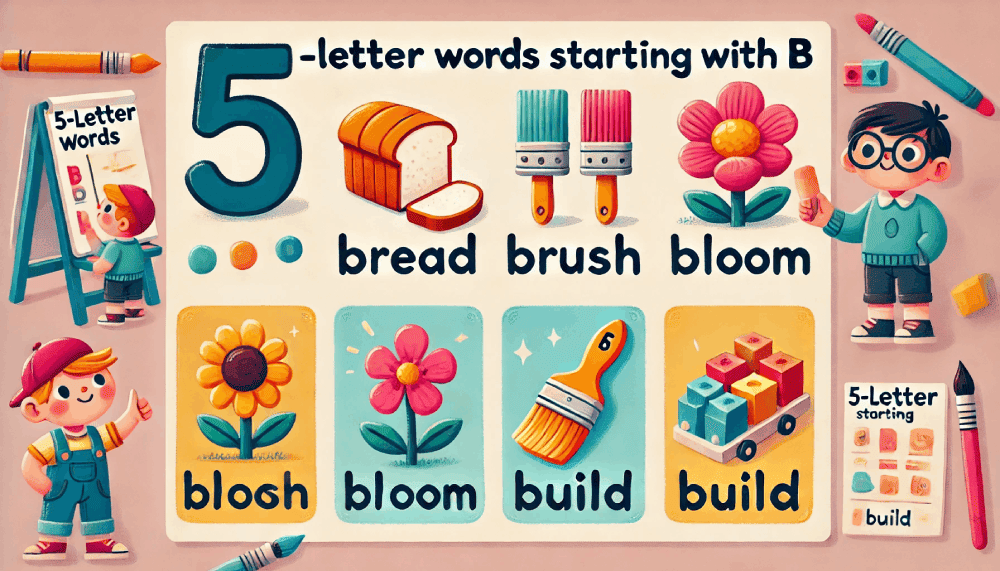
This guide walks you through the most helpful categories of 5-letter B-words, their usage in real life, pronunciation patterns, spelling tricks, and their value in games like Wordle and Scrabble. Let’s dive in!
5-Letter Words Starting with B
Common Usage Categories
Understanding 5-letter B-words becomes easier when you group them into categories. This makes learning them faster, clearer, and more memorable.
Everyday Vocabulary (Common & Practical Words)
These are words you see or hear all the time in conversation, social media, stories, and daily communication. They describe everyday objects, activities, and situations.
Examples include:
- objects like bags, books, benches, breads
- simple actions used in daily life
- common personality descriptors
- frequent adjectives describing size, color, or feeling
Such words help you express yourself naturally and clearly.
Action Verbs (Verbs Starting with B)
Many essential English verbs start with B, and 5-letter forms are especially important for building sentences. These verbs describe actions you do, observe, or explain.
Common types include:
- Movement verbs: bend, block, bound
- Thinking verbs: blame, believe
- Creation verbs: blend, build, brew
- Social interaction verbs: bless, brief, boast
Learning these verbs will sharpen your writing and give you more control over your expressions.
Descriptive Adjectives
Adjectives starting with B can make writing more vivid, detailed, and expressive. Many 5-letter B-adjectives describe textures, tastes, emotions, and appearances.
Common types:
- Appearance adjectives: blurry, broad, brown
- Personality adjectives: brave, blunt
- Feeling adjectives: bored, brisk
- Taste & texture adjectives: bitter, bland
Great writers and speakers use adjectives like these to paint clearer pictures for their audience.
Academic, Formal & Advanced Words
Some B-words are more formal or technical and often appear in academic reading, business documents, or journalism. Learning these gives your vocabulary a more mature tone.
Examples include:
- bureaucratic terms
- descriptive literary words
- scientific / nature-related words
- advanced synonyms for common concepts
Understanding these helps in exams, professional writing, and advanced conversations.
Word Families & Letter Patterns
Letter patterns help you learn words faster and guess them more accurately in puzzles. B-words have many predictable and useful families.
Common B-Starting Patterns
Some patterns appear frequently at the beginning of 5-letter B-words, making them easier to recognize:
- “Ba–” → basic, batch, brace, bacon
- “Be–” → begin, bench, berry, below
- “Bi–” → birth, binge, billow
- “Bl–” → blade, bloom, blunt, blaze
- “Br–” → break, brush, bring, brisk
- “Bo–” → boost, board, bonus, bound
- “Bu–” → build, bunch, burst, bunny
Studying these families helps with spelling and strengthens your guessing strategy in games.
Common Endings
Many B-words share similar endings, which help in pronunciation and pattern recognition:
- –ed (past forms): baked, boxed
- –er (nouns): baker, biker
- –ly (adverbs): badly, boldly
- –ch (objects/actions): beach, bench
- –st (superlatives or actions): boost, burst
- –nd (descriptive or action-oriented): blend, brand
Spotting these endings helps you decode unfamiliar words.
Wordle & Puzzle Strategies with B-Words
Five-letter B-words are extremely useful in games like Wordle, Scrabble, Quordle, and other word puzzles.
Here’s how they help:
Why B-Words Are Great Wordle Starters
B isn’t the most common first letter in Wordle answers, but many B-words contain high-frequency letters like:
- vowels: A, E, I, O, U
- strong consonants: R, N, L
Good example starter guesses include:
- below – contains 2 vowels + useful consonants
- baler – includes A, E, R, L
- bring – tests several common consonants
Tricky But Common Puzzle Patterns in B-Words
Some B-words can be challenging but appear often in word games. Recognizing them helps you avoid losing guesses.
Tricky forms include:
- double letters → belly, bloom, bossy
- cluster consonants → brush, blunt, brisk
- vowel-heavy words → beach, beam, beard
- uncommon-end patterns → bliss, badge, booth
Knowing these makes your word strategy more powerful.
Good Words for Narrowing Down Answers
Some B-words contain a balanced mix of letters that help you eliminate possibilities quickly:
- blaze – tests A, E, L, Z
- bingo – tests multiple vowels + N, G
- burst – tests strong consonants
Use them after your first guess to lock in patterns quickly.
ESL / Learning Tips for B-Starting 5-Letter Words
English learners often find B-words easier because the letter B is straightforward to pronounce and appears in many languages. Still, there are learning tricks that can help you master this vocabulary.
Pronunciation Tips
Pay attention to:
- Bl– vs Br–
blade vs. brace - Bo– vs Bu–
bonus vs. bunny - The silent B
Not common in 5-letter B-words, but appears in related forms like “bomb / bomber.”
Practice tongue placement for B: lips closed → release with a soft burst of air.
Memory Tricks
Group words into themes for faster learning:
- Food words: bread, bacon, berry
- Nature words: beach, bloom, breeze
- Action words: build, break, block
- Emotion words: bliss, bored, brave
Themed learning helps recall words more quickly.
Common Spelling Mistakes
Watch out for:
- double letters (belly, bunny)
- l vs r confusion (blame vs. brave)
- vowel order (beach vs. bache — one is correct!)
Practice writing tricky words multiple times to reinforce spelling.
Fun Activities & Worksheets
Learning 5-letter B-words can be enjoyable when paired with interactive activities:
Fill-in-the-Blanks Worksheets
Provide sentences missing a B-word and ask learners to choose the correct one. This strengthens context understanding.
Word Sorting Activity
Sort words by categories:
- verbs
- adjectives
- objects
- nature
- feelings
This reinforces vocabulary grouping.
Word-Matching Games
Match each B-word to its meaning, picture, or example sentence.
Wordle Practice & Strategy Using B-Words
Wordle or Wordle Unlimited is one of the most effective tools for mastering 5-letter vocabulary, and 5-letter B-words are especially helpful because they contain a good balance of vowels and common consonants. Incorporating B-words into your Wordle warm-up routine helps learners quickly recognize letter patterns, eliminate incorrect guesses, and narrow down solutions more efficiently.
✔ Use B-Words as Strategic Starter Guesses
Although B isn’t the most common starting letter in Wordle, many B-words contain high-frequency letters like A, E, I, O, R, L, N, and T. Good opener examples include:
- below – includes E, O, L and tests W
- baler – includes A, E, R, L
- bingo – covers I, N, G, O
- blaze – checks A, E, L, Z
These guesses give you strong information early in the game and help reduce your remaining possibilities.
✔ Train Recognition of Letter Patterns
B-words are great for practicing tricky Wordle patterns, such as:
- Double letters: belly, bossy, bloom
- Consonant clusters: brush, blunt, brisk
- Vowel-heavy words: beard, beach, beam
- Unexpected endings: badge, booth, bliss
When learners practice with these patterns, they gain confidence and accuracy when solving real Wordle puzzles.
✔ Turn B-Words Into a Daily Wordle Warm-Up
Create a simple routine:
- Choose one random B-word each day.
- Use it as your first or second Wordle guess.
- Observe which letters turn yellow or green.
- Use that feedback to practice narrowing down possibilities.
This builds muscle memory for puzzling through patterns, especially useful for beginners or ESL learners.
✔ Classroom or Group Wordle Challenge
For teachers or group activities, create a “B-Word Wordle Challenge”:
- Give learners 5–10 curated B-words.
- Have them guess the correct one within six tries.
- Provide clues after each round.
- Use real Wordle-style color coding (🟩🟨⬛).
This turns vocabulary practice into a fun, engaging game that encourages deductive reasoning.
✔ Why Wordle Is Perfect for Learning B-Words
Wordle reinforces:
- spelling accuracy
- letter arrangement skills
- vocabulary recognition
- pattern-based guessing
- logical thinking
Because the game limits you to 5 letters, it naturally trains your brain to notice structure, endings, and common English word patterns—making B-words an ideal practice set.
5-letter words beginning with B are widely used, easy to learn, and extremely valuable for building communication skills, improving writing quality, and boosting puzzle performance. By recognizing common patterns, practicing pronunciation, and using fun learning activities, you can quickly expand your vocabulary and strengthen your understanding of English.