
Five-letter words starting with M sit at a sweet spot of the English language—they’re short enough to learn quickly but meaningful enough to express ideas with clarity and detail. From everyday speech to writing, storytelling, and word games, M-words appear almost everywhere. They cover actions, emotions, objects, places, and even abstract ideas, making them valuable for learners of all ages.
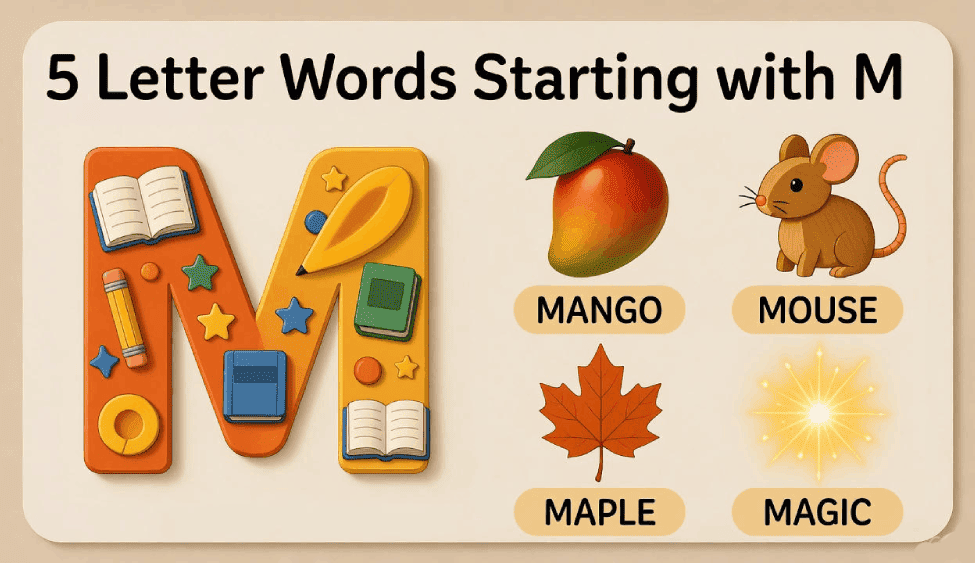
Let’s explore how 5-letter M-words work, what patterns they follow, and how you can learn and use them more naturally.
5-Letter Words Starting with M
⭐ Why 5-Letter M-Words Are So Useful
The letter M produces a friendly, smooth sound, which makes many M-words easy to pronounce and remember. Children learn “m” early because it appears in simple, comforting words like mom, meal, milk, and man. This early familiarity carries into reading, writing, and vocabulary building.
Five-letter M-words often describe:
- Everyday actions
- Common objects
- Food, nature, and places
- Feelings or personality traits
- Creative concepts and storytelling elements
Because of this variety, M-words work beautifully in both casual communication and academic writing.
⭐ Common Meaning Patterns in M-Words
While M-words are diverse, many of them fall naturally into several meaning groups. Understanding these categories helps learners remember and use them more effectively.
1. Words About Movement or Action
Many M-words are verbs, often describing motion, change, or progress.
These words are clear, lively, and often used in instructional writing or storytelling.
2. Words Related to People, Feelings, and Relationships
Some M-words describe emotions—both positive and negative—or character traits.
They can also refer to roles, personalities, or social interactions.
3. Words About Everyday Objects
Since many household items or familiar things begin with M, this group is great for young learners. These provide excellent visual examples for early vocabulary lessons.
4. Words from Nature
Plants, animals, natural features, and environmental terms make up another useful group of five-letter M-words. They enrich science lessons and help kids describe the world around them.
⭐ Using 5-Letter M-Words in Writing
If you’re looking to make your writing more expressive, five-letter M-words can help in several ways:
✔ Add clarity through specific nouns
Words referring to everyday objects or tools help readers understand exactly what you mean.
✔ Create stronger imagery
Descriptive M-words can help set scenes or moods in creative writing.
✔ Make dialogue sound natural
Because many M-words are common, they fit smoothly into conversations or storytelling.
✔ Improve academic writing
Certain M-words are accurate and neutral, making them suitable for school essays or reports.
⭐ Learning Tips: How to Master M-Words
Whether you’re a student, teacher, or someone improving vocabulary for fun, here are engaging ways to learn 5-letter M-words:
✔ Group by themes
Sorting by emotion, nature, food, or action helps organize your memory.
✔ Use visual associations
Picture the item or action.
A mental image makes the word stick faster.
✔ Create personal sentences
Writing your own sentences gives the word emotional meaning.
✔ Turn words into mini-stories
Try to use 3–4 M-words together in a short creative paragraph.
✔ Practice pronunciation aloud
The “m” sound is soft, so saying the word out loud helps train speaking rhythm.
⭐ Using M-Words in Word Games
Five-letter M-words are extremely useful in puzzle games—especially ones that depend on pattern recognition, like Wordle.
🟩 Using M-Words in Wordle
M appears often at the start or middle of five-letter words.
Guessing a strong M-word:
- Gives you a common consonant
- Offers vowel-heavy patterns
- Helps eliminate many word possibilities
Because M blends naturally with all vowels, it’s great for early-game guesses.
🟩 Using a Wordle Solver to Study Patterns
If you’re practicing or analyzing puzzles, a Wordle solver can help you:
- See which M-words appear often
- Identify vowel placement patterns
- Build a stronger guessing strategy
Solvers are great for learning, as long as you use them as guides, not shortcuts.
⭐ Fun Classroom & Learning Activities
Here are creative, teacher-friendly activities using 5-letter M-words:
🎨 Word + Drawing Matching
Students match illustrations (mask, mango, mouse, money) to the correct word.
🧩 Fill-in-the-Blanks
Give incomplete letters for students to complete.
This encourages spelling awareness and phonetic recognition.
🎲 Roll-a-Word Game
Assign numbers to letters.
Students roll dice to create random M-words and decide whether they are real or invented.
✍️ Mini Writing Prompts
Challenge learners to write a 4-sentence story using at least three M-words.
📘 Vocabulary Ladder
Begin with a simple M-word and climb to more advanced ones by adding context or synonyms.
⭐ Conclusion
Five-letter words starting with M are friendly, flexible, and full of meaning. Whether you’re building foundational vocabulary, improving writing skills, or sharpening your word-game strategies, M-words provide endless opportunities for learning.
They’re easy to teach, fun to practice, and valuable across reading, speaking, and reasoning. Exploring them naturally leads to richer stories, clearer communication, and stronger linguistic confidence.