
Five-letter words are some of the most important building blocks in English. They’re long enough to carry meaningful ideas while still short enough to appear frequently in everyday writing, conversations, and word games. Among these, 5-letter words starting with C form a particularly rich group. They include common daily vocabulary like chair and catch, descriptive words like calm and clean, action verbs like chase and crawl, and even trickier terms useful for puzzles.
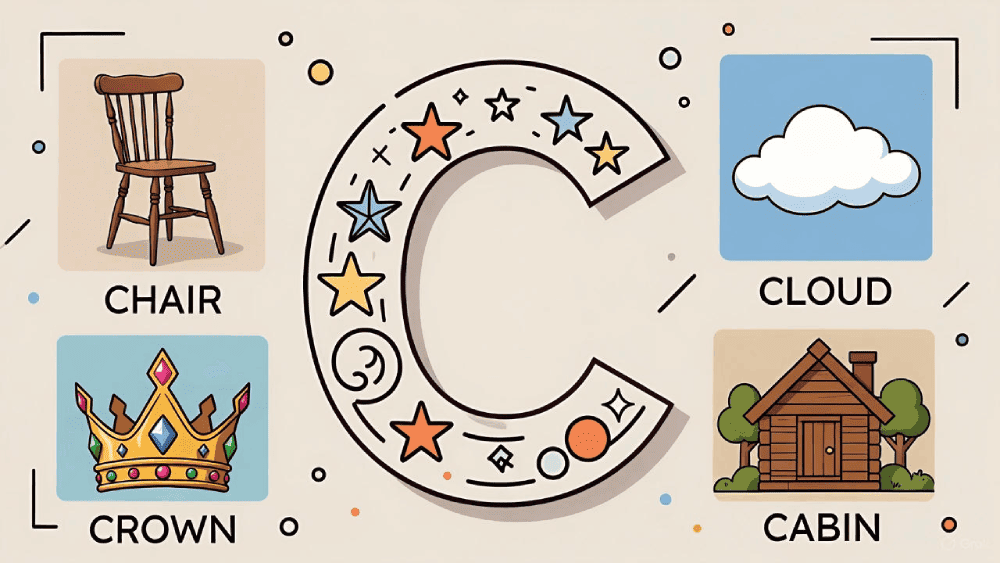
Because the letter C can sound like k, s, or even ch, C-words are interesting to explore and can strengthen both spelling and pronunciation skills. Whether you’re a student, a teacher, a writer, or a Wordle lover, this guide will help you get the most out of these valuable words.
5-Letter Words Starting with C
Common Categories of “C” Words
Everyday Objects
Plenty of practical nouns begin with C, such as:
- chair, cable, clock, crown, crate, cloth
These words help learners describe their physical environment clearly.
Descriptive or Personality Words
Adjectives bring writing to life, and English contains many five-letter C-adjectives:
- calm, clean, civil, cozy, crazy, crisp
These are great for descriptive writing and storytelling.
Action Verbs
Strong verbs make sentences energetic. Examples include:
- crawl, chase, catch, carve, crack, count
These verbs are especially helpful for young learners who are building sentence-writing skills.
Nature & Environment
Many natural terms begin with C:
- cloud, coral, cedar, crane, camel, cocoa
Great for science units or thematic vocabulary lessons.
Academic & Higher-Level Words
Some C-words are useful for advanced learning:
- civic, cynic, cello, canon, chart, cipher
Perfect for older students or ESL learners expanding academic vocabulary.
Why 5-Letter C-Words Matter in Word Games
If you enjoy Wordle, Scrabble, Spelling Bee, or other vocabulary puzzles, C-words are extremely helpful.
Why C-Words Are Valuable
- C is common, so 5-letter guesses beginning with C often appear in daily puzzles.
- Many word patterns start with C + vowel, which helps players test options quickly:
ca-, ce-, ci-, co-, cu- - C can mimic other sounds, which introduces both challenge and strategy.
C in Wordle
Wordle players benefit especially from learning tricky C patterns:
- CH- words (e.g., choir, chest, chill)
- CR- words (e.g., crisp, crown, craft)
- CL- words (e.g., clean, climb, clock)
- CA- and CO- starters, two of the most common openings
Many Wordle solutions in the past have used C-words, making this category essential for puzzle enthusiasts.
Spelling & Pronunciation Tips for C-Words
Because C is one of the most unpredictable letters in English, mastering its pronunciation is especially useful.
Hard C (k sound)
C usually sounds like /k/ when followed by:
- a, o, u → camp, cold, curve
- Any consonant → crisp, climb, craft
Soft C (s sound)
C sounds like /s/ when followed by:
- e, i, y → cycle, cedar, cider, cease
A common rule to teach children:
“E, I, and Y make C say S.”
The “CH” Sound
C forms the “ch” sound when paired with H:
- chair, chest, charm, chore
However, English also contains exceptions (Greek roots), like:
- chaos (sounds like K-ay-oss)
- chorus (sounds like K-o-rus)
These exceptions are great to highlight in advanced vocabulary lessons.
Double C
CC can be tricky because it creates two effects:
- /ks/ as in accent
- /k/ as in occur
Teaching the vowel-after rule helps reduce confusion.
How to Teach & Learn C-Words More Effectively
Grouping by Pattern
Organize words by starting blend:
- CL- words: clock, clean, climb
- CR- words: crane, creep, craft
- CH- words: chess, chase, chain
- CA- and CO- groups: large families with predictable sounds
Pattern grouping is one of the fastest ways to expand vocabulary.
Storytelling Using C-Words
Have students write a short paragraph using 5–10 C-words.
Example prompt:
“Write a story about a crazy camel climbing a cloud-covered cliff.”
This strengthens creativity and retention.
Flashcards & Spelling Races
Use flashcards for:
- Meaning recall
- Real-life examples
- Pronunciation practice
- Speed writing challenges
Gamifying the process makes vocabulary more engaging.
Context Reading
Encourage learners to find C-words in:
- Short stories
- News articles
- Classroom books
- Game instructions
Highlighting them improves comprehension and active usage.
Fun Activities & Worksheets
Learning 5-letter C-words can be fun when paired with interactive activities. Here are a few ideas for classrooms and self-study:
C-Word Bingo
Create bingo sheets filled with common C-words.
Call out meanings or clues instead of the words themselves to encourage deeper thinking.
Match the Picture
Pair simple illustrations with vocabulary like:
- chair, crown, cello, cabin
Learners draw a line from each word to the right image.
Fill-In-the-Blank Sentences
Great for practicing context:
- “The cat tried to ____ the mouse.” (chase)
- “The sky was full of white ____.” (cloud)
Word Sorting Challenge
Sort words by:
- Part of speech
- Sound pattern
- Vowel family
Wordle-Style Classroom Game
You can recreate a Wordle challenge where the teacher chooses a 5-letter C-word and students guess.
They use clues like:
- correct letter
- correct position
- or mis-placed letter
This reinforces spelling, logic, and vocabulary at the same time.
Bonus: Why C-Words Are Perfect for Wordle Players
Wordle often uses words like:
- civic
- cater
- couch
- candy
- crown
- crane
Players who memorize C-patterns gain a huge advantage because many of them reappear in official puzzle solutions.
Using a Wordle Solver with C-Words
“A Wordle Solver can be a great companion when practicing 5-letter C-words. Instead of randomly guessing, students and puzzle players can analyze word lists, check valid guesses, and discover new words that fit specific patterns. This turns the tool into both a learning aid and a strategy booster.”
Five-letter words beginning with C are essential for learners, writers, and word-game lovers. They appear everywhere in English—from daily objects to advanced academic vocabulary—and they offer a great opportunity to practice spelling rules, sound patterns, and context usage.
Whether you’re strengthening your English skills, preparing educational materials, or sharpening your strategy for Wordle, mastering 5-letter C-words will expand your communication and improve your language confidence. As you continue exploring, try grouping words by sound, using flashcards, writing stories, or playing C-themed vocabulary games.
With the right practice, these C-words will become some of the most powerful tools in your vocabulary toolkit!