
The letter D is one of the earliest consonants learned by developing speakers and readers. In English, D-words show up across emotional vocabulary (“dream,” “doubt”), action verbs (“drive,” “dance”), descriptive adjectives (“dull,” “dense”), and concrete nouns (“desk,” “donut”). This makes them practical for every age group—from school learners to adults preparing for language exams or playing word games.
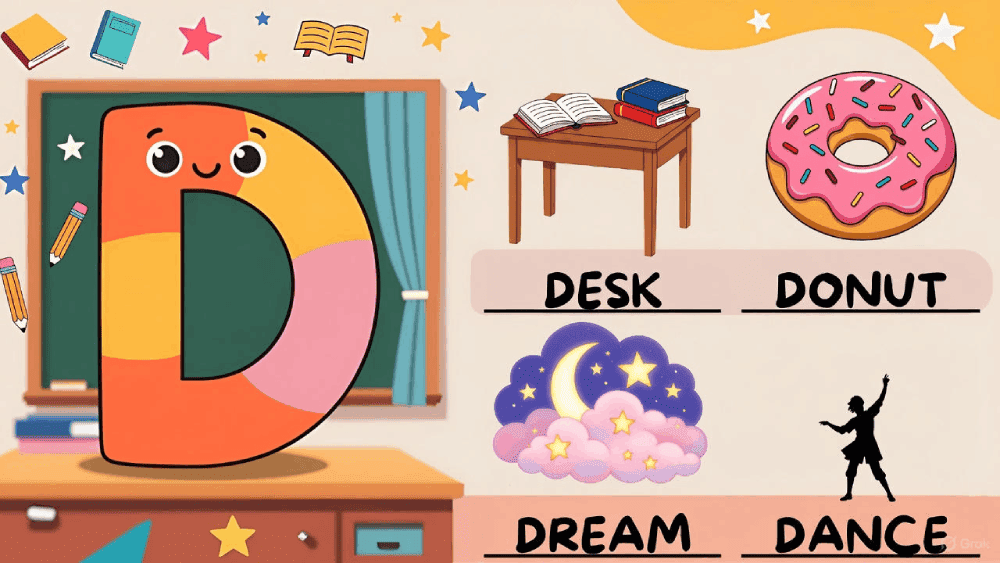
Five-letter words are some of the most important building blocks in the English language, and those beginning with the letter D are especially rich in meaning, versatility, and everyday usefulness. Whether you’re improving your vocabulary, learning English as a second language, or simply sharpening your puzzle-solving skills for games like Wordle, Scrabble, or Crossword challenges, 5-letter D-words can open doors to clearer communication and smarter strategy.
5-Letter Words Starting with D
Common Prefixes & Patterns in 5-Letter D-Words
One of the easiest ways to master D-words is by observing patterns. English uses several predictable structures, and recognizing them makes spelling and memorization much easier.
1. The “Dr-” cluster
Many popular 5-letter D-words start with “dr,” often referring to movement or physical action:
- drag
- drink
- drive
- drift
Because this prefix uses a fast consonant blend, D-words starting with “dr-” are excellent for practicing pronunciation and articulation.
2. The “De-” prefix
The most productive prefix in English beginning with D, “de-” often means:
- reverse (declog)
- remove (debug)
- reduce (decrease)
- down from (descend)
This helps learners decode new vocabulary when they encounter unfamiliar de-words.
3. The “Dis-” prefix
“Dis-” expresses:
- opposite (disconnect)
- lack (dishonest)
- remove (disarm)
You’ll find many 5-letter verbs and adjectives beginning with “dis-,” which helps with grammar pattern recognition.
4. The “Do-” group
These words usually relate to objects, daily routines, or simple actions:
- donut
- dodge
- donor
- dough
This group is especially friendly for young learners and ESL students.
5. The “Du-” group
“Du-” often relates to doubling, sound, or power:
- dummy
- dutch
- dunes
- duvet
Although less frequent, these words are memorable and fun to practice.
Pronunciation Tips for D-Words
Pronouncing D-words accurately matters for communication, especially because the “d” sound can vary depending on the letters that follow.
Here are helpful tips:
1. “D” at the beginning is a voiced consonant
Place your tongue lightly behind your upper teeth and let your vocal cords vibrate.
Example: dine, doubt, dance
2. The “dr-” sound blends quickly
Say “d” and “r” together without pausing.
It should sound like “jr” in fast speech for many accents.
Example: dream, drink, drape
3. The silent “b” in some D-words
A small number of D-words have silent letters, such as the b in “doubt”.
This can trick learners, so memorizing these exceptions helps spelling accuracy.
4. The “di-” and “de-” vowel difference
- “di-” usually sounds like “dye” (as in diner)
- “de-” usually sounds like “dee” or “duh” depending on stress (as in demon vs detail)
5. Watch for “do-” vowel changes
English “o” can sound like:
- “oh” → donor, donut
- “aw” → dodge, docket
- “oo” → dough, doing
Mastering these patterns improves reading fluency.
How 5-Letter D-Words Improve Your Word-Game Skills
Word games reward players who understand letter frequency, patterns, and common letter combinations. D-words happen to be extremely useful for guessing early letters and narrowing down possibilities.
Here’s why:
✔ D is a moderately common starting letter
Not as rare as “J” or “V,” but not as frequent as “S” or “C.”
This makes D a strategic guess in games like Wordle when you already eliminated common letters.
✔ D pairs well with vowels
Words like dealt, dream, drift, donut, diner show how flexible D is.
This helps players form guesses even with limited information.
✔ D often appears with R, L, and W
Blends such as dr-, dw-, and dl- give useful structural hints in word puzzles.
✔ Great for pattern recognition
If you know the word starts with D and ends in a specific letter, you can eliminate dozens of options quickly because D-words follow predictable shapes.
Using a Wordle Solver for D-Words
If you practice Wordle, a Wordle Solver tool can help you analyze patterns in D-words, check valid guesses, and understand which letter positions D commonly occupies. You shouldn’t rely on it for answers, but it’s a smart way to train your brain for future puzzles and build confidence in your vocabulary.
Learning Tips for Mastering D-Words
Improving your vocabulary is easier when you follow structured learning strategies. Here are proven methods to make D-words stick:
1. Group by Meaning
Study D-words by theme:
- Food → donut, dairy
- Nature → dunes, delta
- Actions → drain, dance
- Feelings → dread, doubt
This helps your brain make semantic connections.
2. Group by Grammar Type
Sort D-words into:
- Nouns (desk, dough, depot)
- Verbs (dodge, delay, dwell)
- Adjectives (dizzy, dusty, dense)
Understanding function improves usage.
3. Use Memory Hooks
Example memory trick:
- “Dream begins with DR—because dreams often drift.”
Hooks make vocabulary easier to recall.
4. Practice With Sentence Creation
Use five new D-words in your own sentences each day.
The more context you create, the faster they become active vocabulary.
5. Compare Similar Words
Some D-words look alike but differ in meaning:
- dairy vs diary
- diner vs dinner
Spotting differences sharpens spelling.
6. Listen & Repeat
Search audio pronunciations and mimic the rhythm and stress of each word.
Speaking improves memory more effectively than silent reading.
Fun Activities & Games for Learning 5-Letter D-Words
Learning D-words doesn’t have to be boring—here are enjoyable activities suitable for students, classrooms, and self-learners.
1. Wordle Practice with D-Words
Playing Wordle with a D-word mindset is surprisingly effective:
- Begin with words containing common letters like dream or diner.
- Observe where the “d” tends to appear—beginning or middle.
- Try solving custom puzzles using only D-words.
- Use a Wordle Solver to explore patterns and letter placements (not to cheat, but to study).
This builds intuition for future games and strengthens vocabulary.
2. Alphabet Challenge
Pick any letter after D and try forming as many D-words that end with that letter.
Example: words ending in -t, -n, or -y.
This boosts pattern recognition.
3. Flashcard Match
Create cards with:
- one card: definition
- one card: D-word
Mix and match like a memory game.
4. Story-Starter Game
Give students five random D-words and ask them to create a short story that includes all of them.
This makes vocabulary emotionally memorable.
5. Word Family Sort
Sort D-words by their starting pairs:
- dr-
- de-
- di-
- do-
- du-
This reinforces phonics and spelling structures.
Five-letter words begining with D offer learners an exciting space to grow vocabulary, improve pronunciation, and strengthen analytical skills for word games like Wordle. From action-packed verbs to sensory descriptive words and everyday nouns, D-words enrich both writing and conversation.
By studying patterns, practicing pronunciation, and playing vocabulary games, anyone—teachers, students, language learners, or puzzle enthusiasts—can master these versatile and valuable words. With consistent practice, you’ll soon find D-words appearing naturally in your reading, communication, and word-game victories.