
When you begin exploring 5-letter words starting with G, you’ll quickly notice just how flexible and expressive this letter can be. Words beginning with G can sound soft and gentle, like glide or grace, or they can feel strong and energetic, like grasp or guard. This makes G-words especially helpful for learners, writers, and puzzle-solvers who want a vocabulary that “moves” in many directions.
Whether you’re improving everyday communication, boosting your writing skills, or sharpening your Wordle strategy, mastering G-words can guide you toward more confident language use. This article breaks down how these words work, how they’re used, and how you can learn them effectively.
5-Letter Words Starting with G
Why 5-Letter G-Words Matter
Five-letter words strike a beautiful balance: long enough to be expressive, but short enough to remember and apply quickly. When those words begin with G, they often carry meanings related to:
- growth (grow, graft)
- movement (glide, gallop)
- perception or thought (guess, gauge)
- strength and stability (guard, grasp)
- emotion or character (grace, guilt)
Because G is both a physical and emotional letter — expressing action and abstract ideas — G-words appear throughout everyday English. Students, language learners, and word-game enthusiasts benefit greatly from becoming familiar with these forms.
Patterns & Sound Families in G-Words
If you want to memorize and recognize G-words more easily, it helps to notice predictable pattern families. Five-letter G-words often fall into recognizable groups:
a. “Ga–” Words (open, strong sounds)
Words beginning with ga often relate to action, beginnings, or firm movement.
Examples: gather, gauge, gazer
These words tend to feel energetic or directional.
b. “Ge–” Words (sharp or soft depending on usage)
The letter G before E can keep its hard sound (as in get) or turn soft (as in gem).
Examples: genre, genie, germy
This group is great for teaching pronunciation differences.
c. “Gi–” Words (light, crisp sounds)
These words often feel quick or emotional.
Examples: giver, giddy, giant
They’re easy to pronounce and often used in positive or descriptive contexts.
d. “Gl–” Cluster Words
This cluster often reflects smooth movement or shine.
Examples: glide, glare, gleam, globe
This is one of the most recognizable sound families for early learners.
e. “Gr–” Cluster Words
Words starting with gr tend to express firmness, effort, or grounding.
Examples: grasp, grind, grace, grown
Writers love this group for describing physical action or emotional tone.
Understanding these clusters makes recognizing new vocabulary much easier.
Usage Tips: How G-Words Appear in Real Life
a. Everyday Conversations
G-words come up constantly in natural speech:
- “I’ll guess.”
- “Can you grab that?”
- “She showed so much grace.”
- “We need to grow the project.”
Their versatility makes them practical building blocks for communication.
b. Academic & Professional Contexts
Words like graph, grade, grant, govern, and globe appear in schoolwork, presentations, scientific writing, and business communication.
Professionals use G-words to express clarity, organization, or process, such as:
- Grasp an idea
- Gauge the results
- Guide a team
- Generate solutions (longer word but same G-energy!)
c. Creative Writing
In storytelling, G-words help describe:
- movement (glide, gallop, gloat)
- mood (gloom, glad, grim)
- visuals (glitter, glow)
Their sounds make them excellent for rhythm, imagery, and emotional expression.
Wordle & Puzzle Strategies Using G-Words
Five-letter G-words play a huge role in word games—Wordle, spelling puzzles, vocabulary quizzes, and even Scrabble.
Why G is a valuable Wordle starter or second-guess letter
- G is more common than people think.
It appears in many common words but doesn’t always appear where you expect. - It often helps identify a cluster early.
For example, if you correctly place G at the start, you may quickly narrow to gl– or gr– families. - It can eliminate many possibilities at once.
Guessing G early helps you rule out entire sound groups.
Smart Wordle strategies with G
- Use G after determining vowels:
Once you know your vowel (A/E/I/O/U), test words like glide, grape, genre. - Try G-heavy cluster words to test multiple letters at once:
glare, grunt, groan, grind. - Keep G-words in mind for tricky, less common solutions:
Wordle frequently uses words like gawky, glean, girth, which many players overlook.
Including a Wordle Solver (if you mention it in your article) can help players scan all possible G-words quickly, especially when they know only one or two letters.
How to Teach & Learn 5-Letter G-Words
a. Use real-world examples
Write short phrases using the G-words:
- grasp the idea
- glow softly
- gauge the level
- greet politely
This helps the word “stick” inside real situations.
b. Group by theme
Learners remember better when words are grouped by meaning:
- Emotion: glad, guilt, gloom
- Movement: glide, grasp, gallop
- Light/visual: glow, gleam, glare
- Creation/growth: growl, graft, grind
c. Create mini-stories
Example:
“Grace tried to gauge the storm clouds as they began to glide across the gloomy sky.”
Short stories reinforce vocabulary naturally.
d. Use imagery
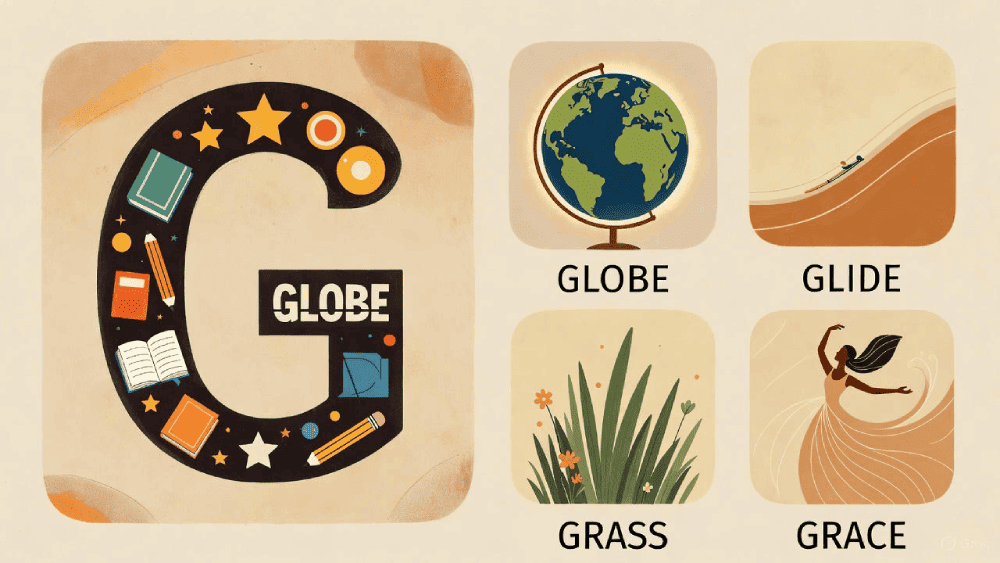
Pairing a word like globe with an illustration or a word like giddy with a funny picture helps memory retention significantly.
Fun Activities & Worksheets
a. “G-Cluster Sort”
Give students mixed five-letter words and ask them to sort them into gl–, gr–, ga–, ge–, and gi– categories.
b. Guess-the-G Word Game
Give clues such as:
- “It means to hold tightly.” → grasp
- “It means to move smoothly.” → glide
- “It means the opposite of sad.” → glad
Students love this quick-thinking activity.
c. Word-Making Challenge
Give learners a starting “G” and ask them to form five-letter words using a limited set of letters.
Great for spelling and vocabulary together.
d. Wordle-style Classroom Grid
Create a mini Wordle game using only G-words.
Students guess the word in six tries while learning pattern recognition.
If you include digital tools, this is a great place to reference a Wordle Solver to help learners explore patterns, verify guesses, and discover new G-words.
Five-letter words begining with G offer a surprising amount of richness and variety. They help you express action, emotion, thought, light, creativity, power, and growth—all through a single starting letter. Whether you’re learning English, improving your writing, solving Wordle puzzles, or teaching vocabulary, G-words give you a strong and flexible toolkit.
By studying patterns, practicing with real-life examples, and engaging with fun learning activities, you’ll soon find that 5-letter G-words are not only easy to remember but also incredibly fun to use.