
Five-letter words beginning with J don’t get as much attention as those starting with more common letters, but they’re surprisingly fun, vivid, and full of personality. Whether you’re building vocabulary for school, teaching English, improving your writing, or sharpening your Wordle skills, J-words bring a special spark to language learning. They’re upbeat, punchy, and often tied to energy, motion, and character—think of words like jumpy, jolly, or jazzy. This makes them great for both teaching and creative play.
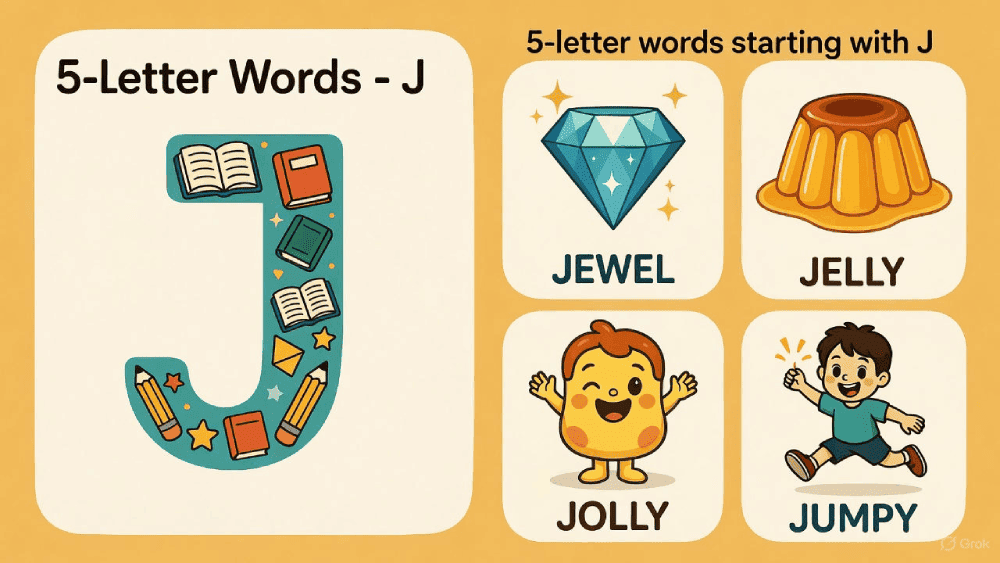
In this guide, we’ll explore why J-words matter, how they appear in everyday communication, and the best ways to use them in reading, writing, and word games.
5-Letter Words Starting with J
Why J-Words Matter in Vocabulary Learning
The letter J creates a very recognizable sound—sharp but friendly, memorable but not too common. For learners, this makes J-words easy to spot and fun to practice. Many J-words relate to:
- Action (jump, jolt)
- Emotions or moods (jolly, jaunty)
- People and roles (joker, judge)
- Objects or daily items (jelly, jewel)
Because J is less common than letters like S, P, or C, these words challenge students to think outside the usual patterns. They’re perfect for expanding vocabulary in a way that feels fresh and playful.
Pronunciation Tips for 5-Letter J-Words
J is usually a straightforward sound, but these tips help learners pronounce J-words confidently:
1. Lead with the “juh” sound
Almost all J-words begin with a soft “juh,” similar to the sound in jump or juice.
This makes them great for phonics practice.
2. Watch out for vowel combinations
Vowels after J can shift the flow of the word:
- ja- (as in japan) feels open and bright
- je- (as in jelly) is sharp and quick
- ji- (as in jiffy) is narrow and fast
- jo- (as in jolly) is round and warm
- ju- (as in jumpy) has a bouncy, energetic sound
These vowel variations keep learning interesting and help students explore how vowel shifts change tone and rhythm.
3. Practice the ending consonants
Some J-words end on smooth sounds like -y, while others end sharply with -mp, -st, or -ck, which helps with articulation practice.
Using J-Words in Sentences & Communication
Five-letter J-words appear across storytelling, conversations, and descriptive writing. They often bring energy or attitude to a sentence. For example:
- Words like jumpy or jazzy instantly add personality.
- Words like judge or juror introduce formality or structure.
- Words like jelly or juice give simple, everyday familiarity.
These words help writers express action, emotion, and character more vividly. J-words also tend to be easy for young learners to visualize, which makes them especially helpful in early vocabulary lessons.
Grammar & Spelling Patterns in J-Words
Here are a few patterns that appear frequently in 5-letter J-words:
1. The “ju-” pattern
Many energetic and expressive words begin with ju-:
jumbo, juicy, jumpy…
They’re memorable and fun for phonics work.
2. The “je-” pattern
One of the most child-friendly patterns, often tied to food or simple objects:
jelly, jewel, jenny…
3. Double letters appear often
Words like jiffy or jolly use double letters to create rhythmic sounds, which helps children hear the beat of syllables more clearly.
4. J + consonant clusters create punchy sounds
Clusters like:
- j + m (jammy)
- j + l (jelly, jolly)
- j + r (jerry, juror)
These combinations help learners practice blending consonants smoothly.
Using J-Words in Word Games & Puzzles
Because J isn’t a common starting letter, J-words bring a fun challenge to word games. They’re especially useful when introducing strategy and helping learners think creatively.
In Classroom Games
J-words work beautifully in:
- Spelling bees
- Speed vocabulary rounds
- Category games (“Words that start with J… go!”)
- Memory matching games
- Word-building challenges using letter tiles
They strike a good balance between accessible and unique, which keeps students engaged.
J-Words in Wordle & Word Puzzles
Five-letter J-words are highly strategic in Wordle and other puzzle games because:
- J is uncommon, so discovering it early can drastically narrow choices.
- Vowel-rich J-words like juice or jumpy reveal multiple vowel positions at once.
- Repeating letters (like the double L in jolly) force players to think about patterns they might overlook.
Using a Wordle Solver with J-words
Some puzzles get tough when the solution uses rare letters. A Wordle solver becomes helpful when:
- You discover a J early and want to filter valid options
- You’re stuck with vowel placement
- You need to test multiple vowel patterns quickly
Adding J-words into solver tools makes the guessing process faster and more accurate.
Fun Activities & Worksheets for Teaching J-Words
If you’re teaching children or ESL learners, here are creative ways to practice 5-letter J-words:
1. Draw & Spell
Students draw simple pictures—like jelly, jewel, or jumpy—and write the word underneath.
2. J-Word Charades
Act out words like jolly, jumpy, or jiggy for others to guess.
3. Fill-the-Blank Stories
Create short, silly stories with missing J-words for students to fill in.
4. Word Sorting
Sort J-words by:
- starting vowel (ja-, je-, ji-, jo-, ju-)
- type (emotion, object, action)
- ending pattern (-ly, -mp, -ce, -or)
5. Word Ladders
Change one letter at a time:
jelly → jolly → jolly → jowly, etc.
These activities help learners understand meaning, structure, and usage naturally—without memorization pressure.
Conclusion
Five-letter words that start with J bring color, movement, and personality to the English language. They’re expressive enough for creative writing, simple enough for young learners, and unique enough to make word games more interesting. Whether you’re a teacher crafting lessons, a student expanding vocabulary, a writer looking for richer descriptions, or a Wordle player searching for strategic guesses, J-words give you a lively set of tools to work with.