
Five-letter words beginning with K may not be the first group learners encounter, but they offer a wonderful mix of sharp sounds, expressive meanings, and cultural flavor. K-words tend to be short, direct, and packed with personality—think of words like knack, kites, karma, or koala. They appear across nature, everyday life, creative writing, and even science. That versatility makes them valuable for teachers, students, writers, and puzzle lovers alike.
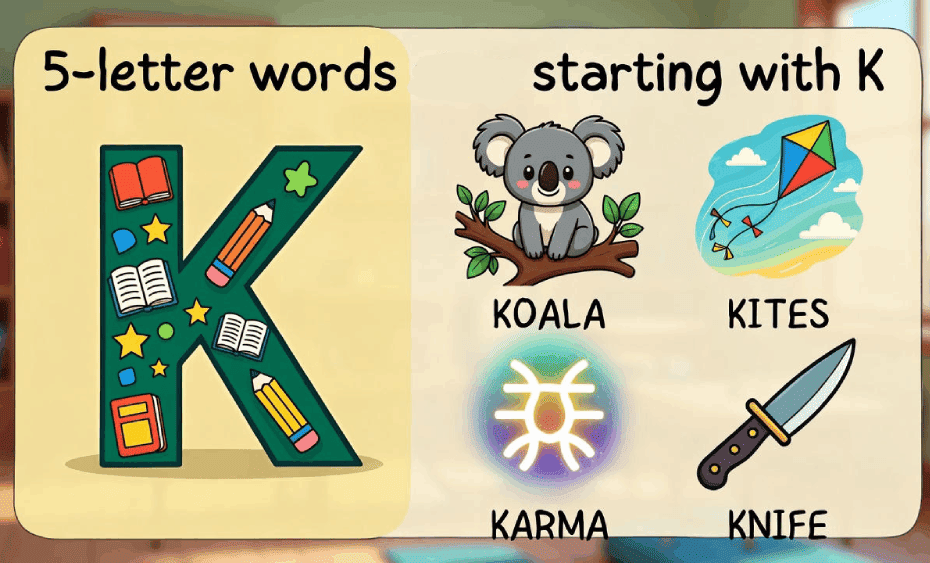
This article explores what makes K-words special, how to pronounce them, how they fit into modern communication, and how to use them effectively in vocabulary building and games.
5-Letter Words Starting with K
What Makes K-Words Special?
The letter K has a crisp, clear sound that makes words feel energetic and confident. Many K-words feel bright or dynamic, giving sentences a sense of movement. Here are a few things that make K-words uniquely useful:
- They often describe actions or abilities (knock, kneel, kayak)
- They name everyday objects (knife, ketchup, knead)
- They represent animals or plants (koala, kelps, kiwis)
- They convey personality or attitude (kooky, kind, keen)
Because K is less frequent than letters like T or S, these words instantly catch the reader’s attention. That makes them perfect for creative writing, hooks, and descriptive storytelling.
Pronunciation Tips for 5-Letter K-Words
Although the K sound is familiar, some K-words include letter combinations that challenge learners. Here are helpful pronunciation pointers:
1. The classic K sound
Most K-words begin with the strong, clean “k” sound, similar to words like cat or car.
2. The “kn-” silent K pattern
A very important pattern in English:
- knife
- knock
- knead
- knack
In these words, the K is silent, and learners should focus on the “n” sound at the beginning. Practicing these helps with mastering English spelling patterns.
3. The “ke- / ki- / ka-” vowel variations
These vowel shifts make K-words interesting:
- ka- feels open and strong (karma, karts)
- ke- is sharp and crisp (keeps, kelps)
- ki- produces a bright sound (kites, kitty)
These patterns help learners tune their ears to vowel differences.
4. “K + L” or “K + R” blends
Words like klutz or krill introduce fun consonant clusters.
Even children enjoy experimenting with these playful sounds.
Using K-Words in Everyday Communication
K-words carry a mix of practicality and charm. Some are simple, familiar, and friendly—like kicks or kitty—while others bring an exotic or cultural tone, such as karma, koala, or kimchi. Because of this range, K-words fit well across different styles of writing:
- Descriptive writing — “A koala sleeps curled like a soft gray cloud.”
- Action scenes — “He knocks gently before stepping inside.”
- Dialogue — “I’ve got a real knack for puzzles.”
- Academic writing — “The krill population affects marine ecosystems.”
Their clarity and punch help sentences feel lively and memorable.
Grammar & Spelling Patterns in K-Words
K-words introduce learners to several unique English spelling rules and patterns:
1. Silent K (kn-)
One of English’s most distinctive patterns.
Perfect for teaching silent letters and historical spelling.
2. K before E and I
This pattern prevents confusion with “C,” which changes sound before e/i.
Example: keeps vs. cease or kites vs. cider.
3. Double letters
Some K-words contain repeating letters, which help with rhythm:
- kooky
- kitty
These reinforce syllable patterns and sound repetition.
4. Ending with –ck
Words like knock, kiosk, and kick help learners practice the short vowel + ck ending.
Understanding these patterns makes spelling much easier for young learners and ESL students.
K-Words in Word Games & Strategy Puzzles
K-words bring just the right level of challenge to word games. Because K is uncommon but not rare, it adds excitement without making puzzles frustrating.
In Classroom Games
K-words work especially well in:
- Vocabulary relays
- Spelling competitions
- “Guess the word” games
- Picture-to-word matching activities
- Word ladders (e.g., knock → knock → knock → knock with letter swaps)
They’re memorable, and kids often enjoy pronouncing them because the K sound feels strong and fun.
Using K-Words in Wordle & Puzzle Strategy
Five-letter K-words can be extremely strategic in Wordle or Wordle Unlimited and other puzzles:
- If you discover a K early, it eliminates most remaining guesses.
- K often appears in specific positions, especially at the beginning or end.
- Silent K words (like knock or kneel) can surprise players and make great “trick” answers.
Wordle Solver Integration
When you’re stuck, especially with rare letter patterns, a Wordle solver can help filter possibilities that include K, narrow vowel positions, and reveal hidden consonant blends like kr, kl, or kn. This speeds up the process and prevents wasted guesses.
Fun Activities & Worksheets for K-Words
Teaching or learning 5-letter K-words works best with interactive activities. Here are some creative options:
1. Picture Drawing + Labeling
Students draw and label objects such as koala, knife, or kites.
2. Silent K Sorting
Sort words into:
- “Silent K words”
- “Regular K words”
Great for mastering patterns.
3. Word Puzzles & Scrambles
Have learners rearrange letters to form a K-word, then draw the meaning.
4. K-Word Story Challenge
Students write a short scene using at least three K-words—funny, serious, or adventurous.
5. “What’s Missing?” Worksheet
Give students sentences with a blank K-word:
- “The ______ flew across the blue sky.”
- “She has a real ______ for crafting.”
These activities boost pronunciation, creativity, and comprehension while keeping lessons lively.
Five-letter words that start with K bring a refreshing combination of fun sounds, useful meanings, and memorable spelling patterns. Although K is not the most common starting letter, its words are expressive, easy to spot, and incredibly helpful in both vocabulary building and word games. From classroom activities to Wordle strategy, K-words offer learners a great opportunity to grow their language skills while enjoying the process.