
If you’ve ever looked at a five-letter word and felt a tiny spark of excitement, wait until you start exploring all the wonderful ones that begin with T. They’re everywhere — in stories, in conversations, in games, in your notes, even hidden in plain sight on signs and screens. 5 Letter Words Starting with T have a special energy. They feel active, tidy, clever, or quick. And once you start noticing them, you’ll realize just how many tools the letter T gives you for writing, thinking, and playing word games.
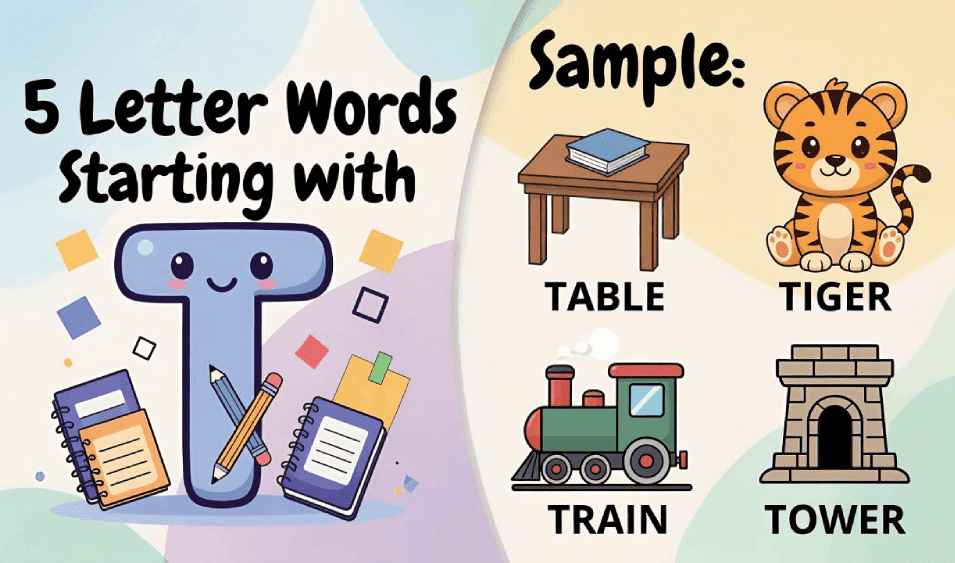
T is one of the most commonly used letters in English, but that doesn’t make it boring. Quite the opposite. Five-letter T-words often come with unpredictable twists, surprising meanings, and a rhythm that feels satisfying to say out loud. If you’re building vocabulary, sharpening writing skills, or just chasing a Wordle win, T-words might become your new favorites.
5-Letter Words Starting with T
What Makes 5-Letter T-Words Special?
Five-letter T-words hit a sweet spot: short enough to be memorable, long enough to carry personality. Many of them describe actions, textures, and states of being, which makes them especially useful in stories and explanations. Some come with a punchy “t-sound” at the start, perfect for grabbing attention, while others hide soft surprises in the middle or end. They’re flexible, expressive, and easy to build into sentences.
Meaning Patterns You’ll Often Notice
Even though T-words can be wildly different, certain patterns show up again and again:
- Movement & Action — Many T-words feel energetic: turning, tossing, tilting, tapping.
- Descriptive Power — Others describe qualities: tight, tender, tough, tangy.
- Everyday Vocabulary — A huge portion are words you use without thinking: table, taste, teach, track.
- Tone & Mood Setters — Some T-words instantly create an emotion — tension, trust, thrill.
- Structural Helpers — A few T-words glue sentences together or give clarity (think, truly, there).
Because T is so common, these patterns repeat in ways that help learners quickly build intuition.
How to Use T-Words Effectively in Writing
Five-letter T-words can sharpen your writing by making descriptions vivid and actions clear. Use T-words to:
- Add motion to a scene (“The leaves twist in the wind.”)
- Make characters expressive (“She tucks the note into her sleeve.”)
- Set a mood (“The room feels tense.”)
- Give dialogue more punch (“Try again!”)
- Describe senses more precisely (“The soup tasted tangy.”)
When writing, try swapping vague words for T-words that carry texture, emotion, or direction. They give your sentences backbone without making them long or clunky.
Learning Strategies for 5-Letter T-Words
If you want these words to stick, try approaches that make learning feel natural rather than forced:
- Group them by theme — T-words about nature, food, feelings, or actions.
- Say them out loud to feel their rhythm — the crisp “T” helps memory.
- Use quick sketches to match words with images.
- Write tiny stories using 3–5 T-words at a time.
- Play substitution games — replace a dull word with a T-word that adds spark.
Your brain loves patterns, and T-words are full of them.
Using T-Words in Word Games & Puzzles
Five-letter T-words are incredibly powerful in Wordle, Wordle Unlimited, crosswords, and even homemade puzzles. Because T appears so frequently, starting with a T-word can instantly reveal vowel positions, consonant mixes, and the overall “shape” of the puzzle.
Some T-words contain highly useful vowels, others carry repeating letters, and many help you test common letter endings. Even if the final answer isn’t a T-word, using one early can narrow down possibilities fast. That’s why puzzle lovers keep T-words tucked in their back pockets.
T-Words & Wordle Solver Tools
If you pair five-letter T-words with a Wordle solver, the combination becomes surprisingly strategic. Since T is such a high-frequency letter, entering T-based starters gives the solver richer data, helping it eliminate dead ends and highlight patterns that fit English letter behavior. It’s not just efficient — it’s a great way to learn how word structure works in real time.
Fun Classroom & Study Activities
Teachers, tutors, or parents can use T-words to boost curiosity and creativity:
- T-Word Charades — act out five-letter T-words without speaking.
- T-Word Tiles — create mini tiles with letters and challenge students to form new T-words.
- Describe the Picture — show an image and have students choose the best T-word to match it.
- T-Word Chains — each new word must share two letters with the previous one.
These activities make vocabulary feel alive instead of memorized.
Theme Spotlight: Action-Packed T-Words
A fun group of T-words revolves around movement. Words like twist, throw, teach, trade, track, tilt and treat give your sentences a sense of life. These words work beautifully in storytelling, instructions, or dialogue because the action is built right in.
Theme Spotlight: Tasty T-Words
Food-related T-words add color and comfort. Think toast, tacos, treats, and tarts. Using these in writing instantly wakes up readers’ senses, and they make great vocabulary for younger learners since they’re easy to picture.
Theme Spotlight: Calm & Cozy T-Words
Some T-words feel gentle and peaceful: tidal, tender, tulip, and tonic. These words work well in scenes meant to soothe, describe landscapes, or highlight emotion.
Why T-Words Belong in Every Learner’s Toolkit
Five-letter T-words are flexible, expressive, and unforgettable once you start using them regularly. They help you describe the world more precisely, play smarter in puzzles, and write with more style and confidence. Whether you’re learning alone, in class, or while playing games with friends, T-words offer endless chances to grow your language skills in a fun, natural way.
Five-letter words that start with T may look small, but they carry a surprising amount of power. They help you describe movement, emotion, texture, and everyday moments with clarity and personality. They make stories livelier, explanations sharper, and Wordle strategies smarter. Most importantly, they invite you to play — with sounds, meanings, and ideas. The more T-words you explore, the more confident and creative you’ll feel as a writer, reader, or puzzle solver. So keep noticing them, keep experimenting with them, and let each new T-word become another tool in the way you express the world.